“Neben dem
Privaten wirkt
die
Inszenierung,
die Distanz
zum Vertrauten
schafft.”
Schattenbock(sen) statement
EN
The paintings of the series “Schattenbock(sen)” originate from my naked body. I depict it in provocative poses, sometimes from an extreme low-angle perspective. In doing so, I confront the viewers head-on; kneeling, I lock their gaze. Challenging and scrutinizing, I invite them into my personal combat zone. Through these perspectives, I stage my relationship to my own sexuality and to its objects of both desire and repulsion. The autobiographical object of fear—the school gym vaulting horse (“Turnbock”)—is partially subverted: it intertwines with the body in an act of intimacy, becomes the surface upon which the body is painted, or enters into conflict with it.
Throughout the series, the German expression “Bock haben”—a colloquialism meaning “to feel like it” or “to crave something”—unfolds in multifaceted ways. It is expanded through the connotation of the defiant, rebellious, animalistic Bock (buck or billy goat). By staging vulnerability, rage, and resilience—alongside desire, self-confidence, and empowerment—I explore an emancipatory engagement with the female body, with its attributions and judgments. In the planned painterly confrontation with the object of fear—the Bock—a playful emancipation is staged. The subdued buck bows and, prancing, invites me to the dance. I free myself from my fear, and its threat dissolves. I defeat the shadow buck. We’re eager to meet—curious to encounter one another. (Julie Batteux, 2025)
DE
Die Malereien der Werkserie „Schattenbock(sen)“ gehen von meinem nackten Körper aus. Ich zeige ihn in aufreizenden Posen in zum Teil extremer Unteransicht. So konfrontiere ich die Betrachter:innen mit meiner Front, auf den Knien hockend fixiere ich die Betrachter:innen. Herausfordernd und taxierend lade ich sie in meine persönliche Kampfzone ein. Ich inszeniere durch diese Perspektiven mein Verhältnis zur eigenen Sexualität und deren Lust- und Hassobjekten. Dabei wird der autobiografische Angstgegenstand des schulischen Turnbocks teilweise verkehrt, indem er sich im Liebesakt mit dem Körper verschränkt, zum Malträger für diesen wird oder aber mit ihm in Konflikt tritt.
Innerhalb der Serie entfaltet sich die deutsche Redewendung „Bock haben“, ein Synonym für „Lust haben“ oder „Verlangen“, auf vielschichtige Weise und wird erweitert durch die Konnotation des sich wehrenden, aufmüpfigen, tierischen Bocks. Durch die Inszenierung von Verletzlichkeit, Wut und Widerstandskraft, aber auch von Lust, Selbstbewusstsein und Selbstermächtigung, erprobe ich in der Serie eine emanzipatorische Auseinandersetzung mit dem weiblichen Körper, seinen Zuschreibungen und Bewertungen. In der geplanten, malerischen Konfrontation mit dem Angstobjekt Bock wird eine verspielte Emanzipation in Szene gesetzt. Der bezwungene Bock verbeugt sich und fordert mich tänzelnd zum Spiel auf. Ich befreie mich von meiner Angst und seine Gefährlichkeit weicht. Ich besiege den Schattenbock. Wir haben Bock, uns zu begegnen und kennenzulernen. (Julie Batteux, 2025)

“Verbockt”, oil on canvas, 252 x 180 cm (99,2 x 70,8 in), 2025, © photo: Julie Batteux

“Bockender Blick”, oil on canvas, 250 x 120 cm (98,4 x 47,2 in), 2025, © photo: Julie Batteux
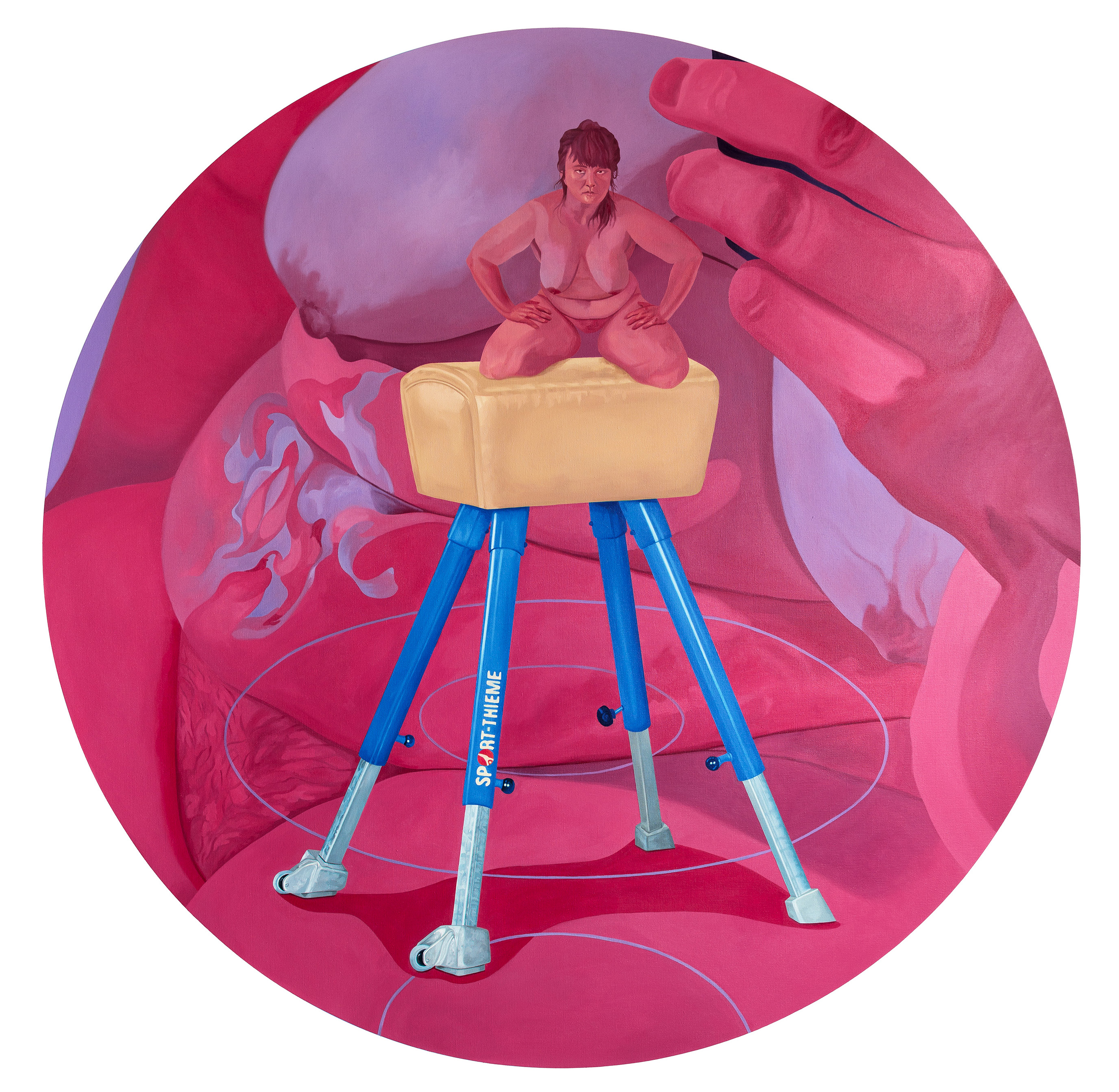
“Der Bock ist ein mieser Verräter”, oil on canvas, 180 x 180 cm (70,8 x 70,8 in), 2024, © photo: Lukas Pürmayr

“Im Auge des Bock´s”, oil on canvas, 240 x 50 cm (94,4 x 19,6 in) (2 pcs.), 23 x 69 cm (9,0 x 27,1 in) (2 pcs.), 2025, © photo: Julie Batteux
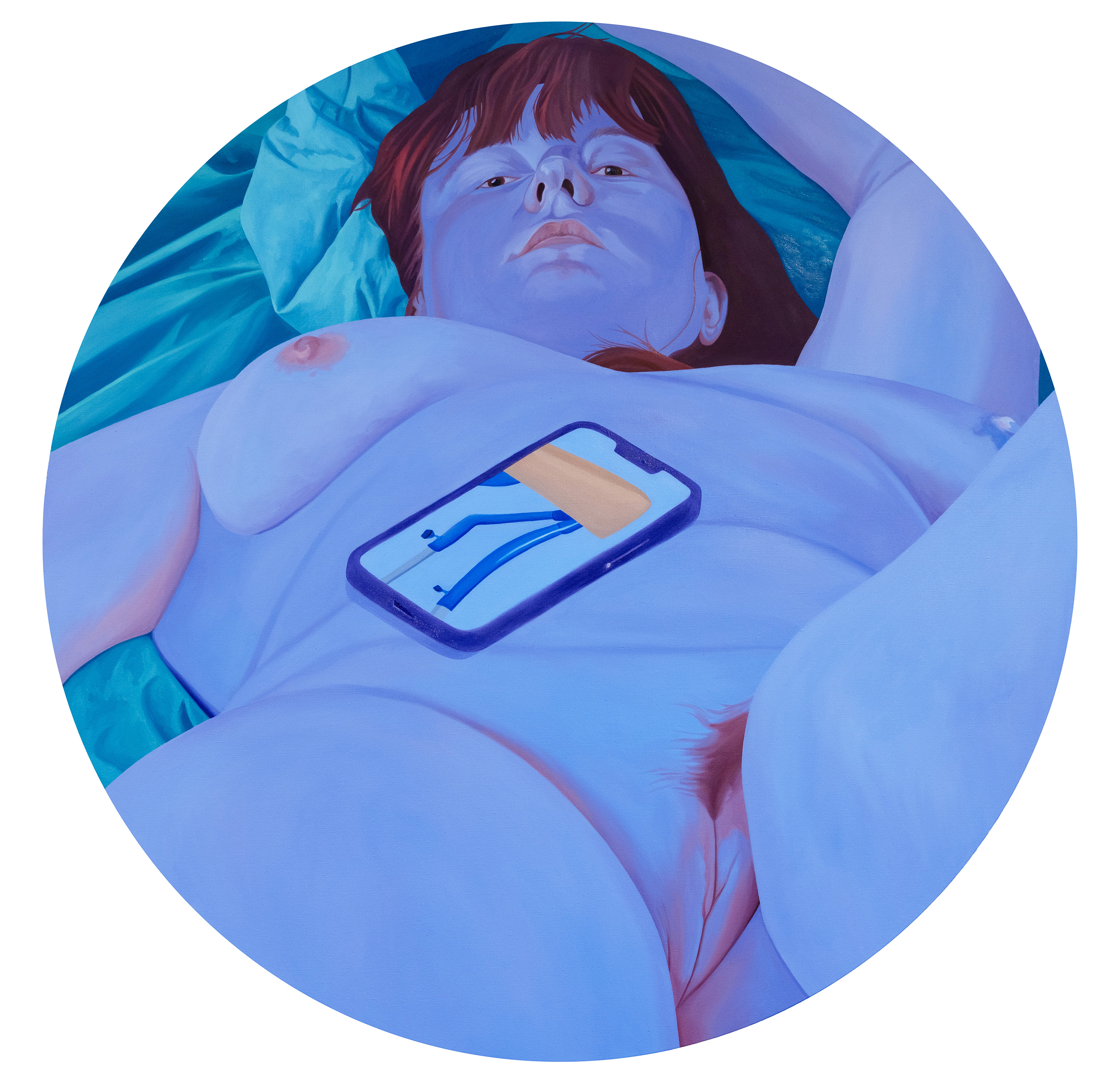
“Bocksuche”, oil on canvas, 120 x 120 cm (70,8 x 70,8 in), 2025, © photo: Julie Batteux

“Bockiges Duell”, oil on canvas, 130 x 175,5 cm (69,0 x 51,1 in), 2025, © photo: Julie Batteux

“Bock auf Bock”, oil on canvas, 120 x 120 cm (70,8 x 70,8 in), 50 x 50 cm (19,6 x 19,6 in) 2024, © photo: Julie Batteux

“Bock Traum(a)”, oil on canvas, 120 x 120 cm (70,8 x 70,8 in), 2025, © photo: Julie Batteux
Spiegelschatten statement
EN
My project “Spiegelschatten” (Mirror Shadows) deals with the aesthetics of social networks, specifically its effects on the psyche of the user. The conformation of selfies to the plain surface of mainstream leaves the feeling of self- esteem scared. Influenced by these ideals, I look at my own female body, knowing well that all humans, even men succumb to these compulsions.
In this ongoing series I explore my body using my cellphone-camera. The phone, almost being a body part, becomes the tool of my body-exploration while also serving as the image-carrier of my paintings. Oberdimensioned to scale the cellphone looses its handy, cute size. Larger than life, it stands monumentally in the room, laning on a wall or laying on the ground. The cellphone monstrously engulfes its surroundings. The proportions between user and phone reverse, mirroring the overwhelming control of the device over its users. My research challenges digital body-ideals and the norms of the Social-Media-World. By revealing my inner doubts on canvas, I reconquer the authorship of my body by painting my personal shadow, thus revealing and embracing it. Out of this self-portrayal a surreal mirror-image of „soul-body“ and „body-soul“ emerges.
With the brush in my hand I gain access to technoid worlds, using the form of the iPhone, and giving it a personal concept. The color-palette focuses on blue, green and violet. This reduced color-repertoire represents the cold, artificial athmosphere the light from the screen produces on flesh and skin. Some mirror-images are in the screenshots themselves, hovering on the canvas, while others have escaped the screenshots and are placed in closed and round forms of a showerhead or peg. Details such as the location, battery and icons are visible or fading into the surreal surroundings. Through the conscious and playfull setting in the paintings, the shapes loose their real source and replace the home-button or the phones’ camera. The circle takes the shape of a magnifying glass or a hand mirror. My selfie dances over the screen like a play ball. The icons flash up in the motifs, small and enigmatic like a tattoo on the screen-skin. I subject this influencial force that has the ability to delete information with one click, giving out likes, faking or idealising pictures, strengthening or weakening the self-confidence, to my own motives. Flowing, glazing and diffuse forms pierce the canvas like a flood of pictures. They take over large parts of the painting and manifest themselves in body parts and unknown beings. The selfies transcend time and space and transform the perception of my person, thus starting a new narrative of my identity. In this spirit my work represents a journey to my inner self. (Julie Batteux, 2023)
DE
Mein Projekt „Spiegelschatten“ beschäftigt sich mit den ästhetischen Leitkulturen sozialer Netzwerke hinsichtlich ihrer Auswirkung auf die Psyche der Nutzerin. Die in Selfies geforderte Anpassung an die glatte Oberfläche der Körperideale des Mainstreams hinterlässt Verletzungen im Selbstwertgefühl. Von diesen Idealen geprägt werfe ich einen Blick auf meinen Körper. Ich verschaffe mir durch verzogene, verzerrte und ungewöhnliche Perspektiven einen neuen Selbstblick. Der kommerziell vereinnahmte Diskurs über Body Positivity übersieht das Gefühl des Versagens, das sich einstellt wenn die Selbstliebe nicht zündet. Eine Selbstliebe, die zur Aufgabe, zur mentalen Arbeit wird und somit erneut Druck auf die betroffene Subjekte ausübt. Ich werde Leibeigene der gesellschaftlichen Debatte ohne Aussicht auf Befreiung des eigenen Leibes. Zu faul, zu undiszipliniert, meinen Körper zu definieren, zu beherrschen. Zu feige, ihn zu lieben und zu akzeptieren. So möchte ich im physischen Prozess der malerischen Reflexion die Autorenschaft über mein Körperbild zurückerobern, indem ich meine intimen Selbstzweifel und Körperängste auf der Leinwand offenbare, meinem persönlichen Schatten begegne, ihn enthülle und mir zu eigen mache.
In dieser noch fortlaufenden Serie erforsche ich meinen Körper im Spiegel meiner Handykamera. Das Handy, fast schon menschliches Körperteil, wird zum Werkzeug meiner Körperforschung und dient zugleich als Bildträger meiner händischen Malerei. Maßstabgetreu überdimensioniert verliert das Handy seine handhabbare, niedliche Größe. Übermenschengroß steht es monumental frei im Raum, lehnt an einer Wand, oder liegt auf dem Boden. So nimmt das Handy monströs seine Umgebung in Beschlag. Das Größenverhältnis zwischen Nutzer:innen und iPhone kehrt sich um und spiegelt installativ die übermächtige Herrschaft des Gerätes über seine Besitzer:innen. Meine Recherche hinterfragt die digitalen Körperideale und Normen der Social Media-Welt. Ich erobere mir malerisch die Autorenschaft über mein Körperbild zurück, indem ich meine intimen Selbstzweifel und Körperängste auf der Leinwand offenbare, meinem persönlichen Schatten begegne, ihn enthülle und mir zu eigen mache. Aus dieser Selbstdarstellung entpuppt sich ein surreales Spiegelbild von Seelenkörper und Körperseele. Körperlichkeit und Emotionalität verschmelzen in diesem Prozess und bedingen sich gegenseitig.
Mit dem Pinsel in meiner Hand nehme ich einen analogen Zugriff auf technoide Welten, bediene mich der Form des iPhones und gebe ihm einen persönlichen Ausdruck. Die Farbpalette konzentriert sich auf Blau-, Grün-, Rot-, Violett- und Fleischtöne. Dieses Farbrepertoire repräsentiert die kühle, künstliche Atmosphäre, die das Bildschirmlicht im Zusammenspiel mit Fleisch und Haut bewirkt. Einige Spiegelbilder befinden sich im Fenster des Screenshot, der im offenen Bildraum schwebt. Details wie Entstehungsort, Akkustand und Icons bleiben erkennbar oder lösen sich in der surrealen Umgebung auf. Andere Selfies haben sich aus den Screenshots befreit und finden ihren Platz in geschlossenen, sicheren, runden Formen eines Duschkopfes oder Abflussstöpsels. Durch die bewusste und spielerische Setzung in die Malerei verlieren die Formen ihren realen Ursprung und ersetzen den Home-Button oder die Handykamera. Der Kreis nimmt die Gestalt einer Lupe oder eines Handspiegels an. Mein Selfie tanzt wie ein Spielball über die Leinwand. Das Selfie nimmt Raum, integriert sich in das iPhone und verdrängt seine Funktionen. Die Icons blinken in den Motiven auf, klein und hintergründig wie Tätowierungen auf der Bildhaut. Diese einflussreiche Macht, die mit einem Klick Information löscht, Likes vergibt, Bilder fälscht, idealisiert, das Selbstwertgefühl stärkt oder schwächt, unterwerfe ich im bildnerischen Prozess meinen Motiven. Fließende, lasierende und diffuse Formen durchdringen die Leinwände gleich einer Bilderflut. Sie nehmen große Flächen des Bildes ein und lassen Trugbilder von Körperteilen, unbekannten Wesen und Gesichtern aus dieser Flut auftauchen. Die Selfies verwandeln sich jenseits von Zeit und Raum in neue Sichtweisen meiner Person und beginnen eine eigene Erzählung meiner Identität. In diesem Sinne begab ich mich in meiner Arbeit auf eine Reise zu mir selber. (Julie Batteux, 2023)
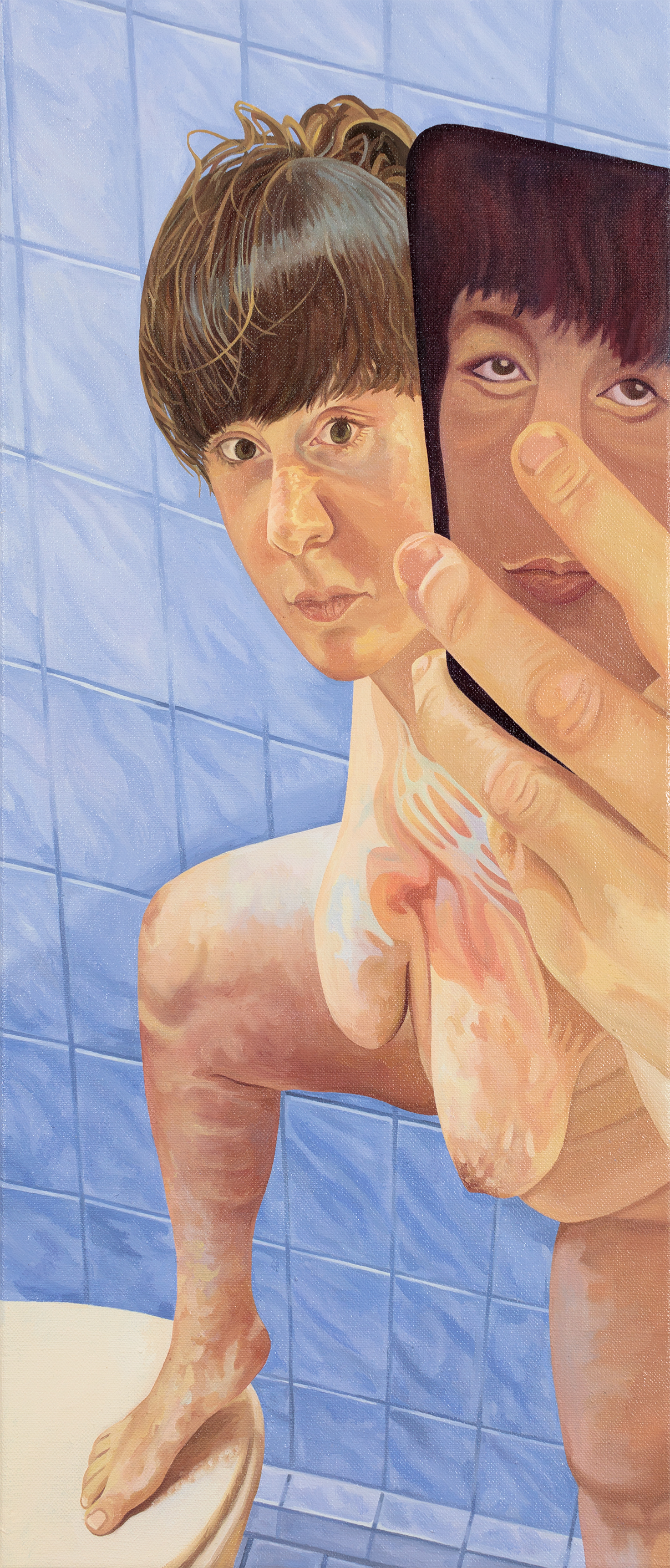
“Mein Spiegelbild mag mich nicht”, oil on canvas, 70 x 30 cm (27,5 x 11,8 in), 2024, © photo: Lukas Pürmayr

“Spiegelblick”, oil on canvas, 30 x 25 cm (27,5 x 11,8 in), 2024, © photo: Lukas Pürmayr
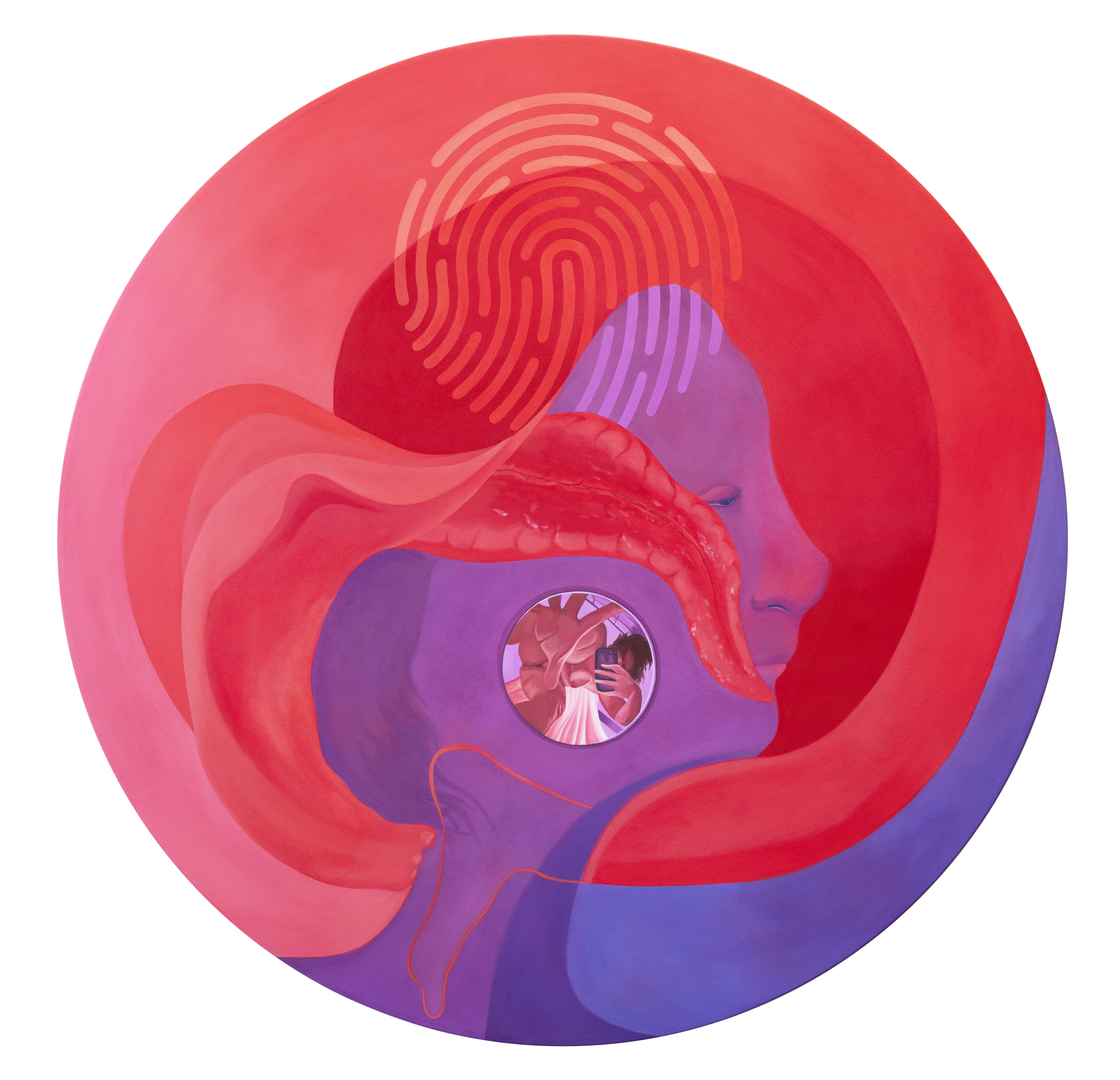
“Entsperre mich #1”, oil on canvas, 115 x 115 cm (45,2 x 45,2 in), 2023, © photo: Julie Batteux

“Entsperre mich #3”, oil on canvas, 30 x 30 cm (11,8 x 11.8 in), 2023, © photo: Julie Batteux

“Entsperre mich #2”, oil on canvas, 59 x 59 cm (23,2 x 23,2 in), 2023, © photo: Julie Batteux

“Kopfüber #1”, Öl auf Leinwand, 220 x 77 cm (86,6 x 30,3 in), 2023, © photo: Julie Batteux

“Kopfüber #2”, Öl auf Leinwand, 220 x 77 cm (86,6 x 30,3 in), 2023, © photo: Julie Batteux
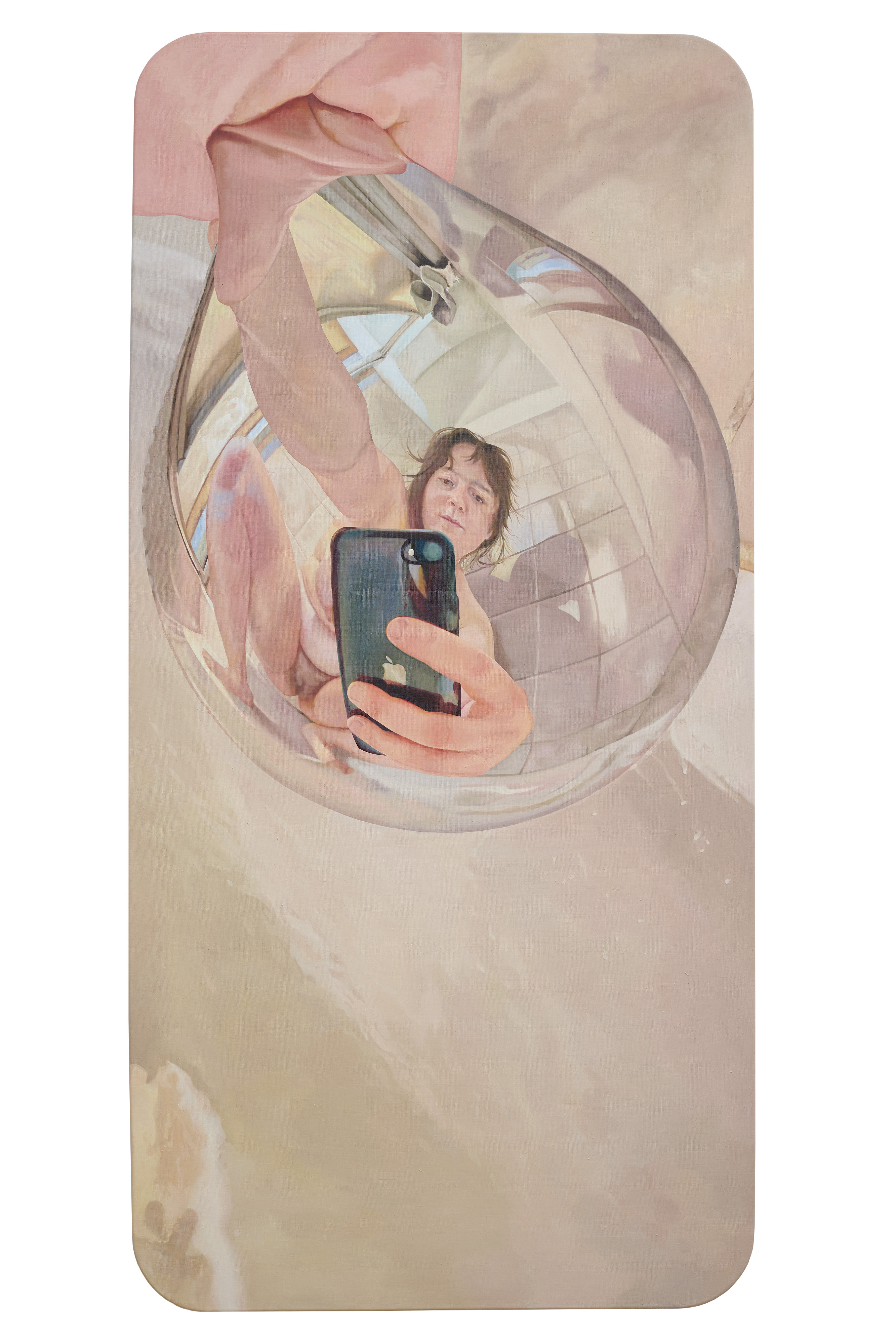
“Display #12”, oil on canvas, 250 x 120 cm (98,4 x 47,2 in), 2023, © photo: Julie Batteux
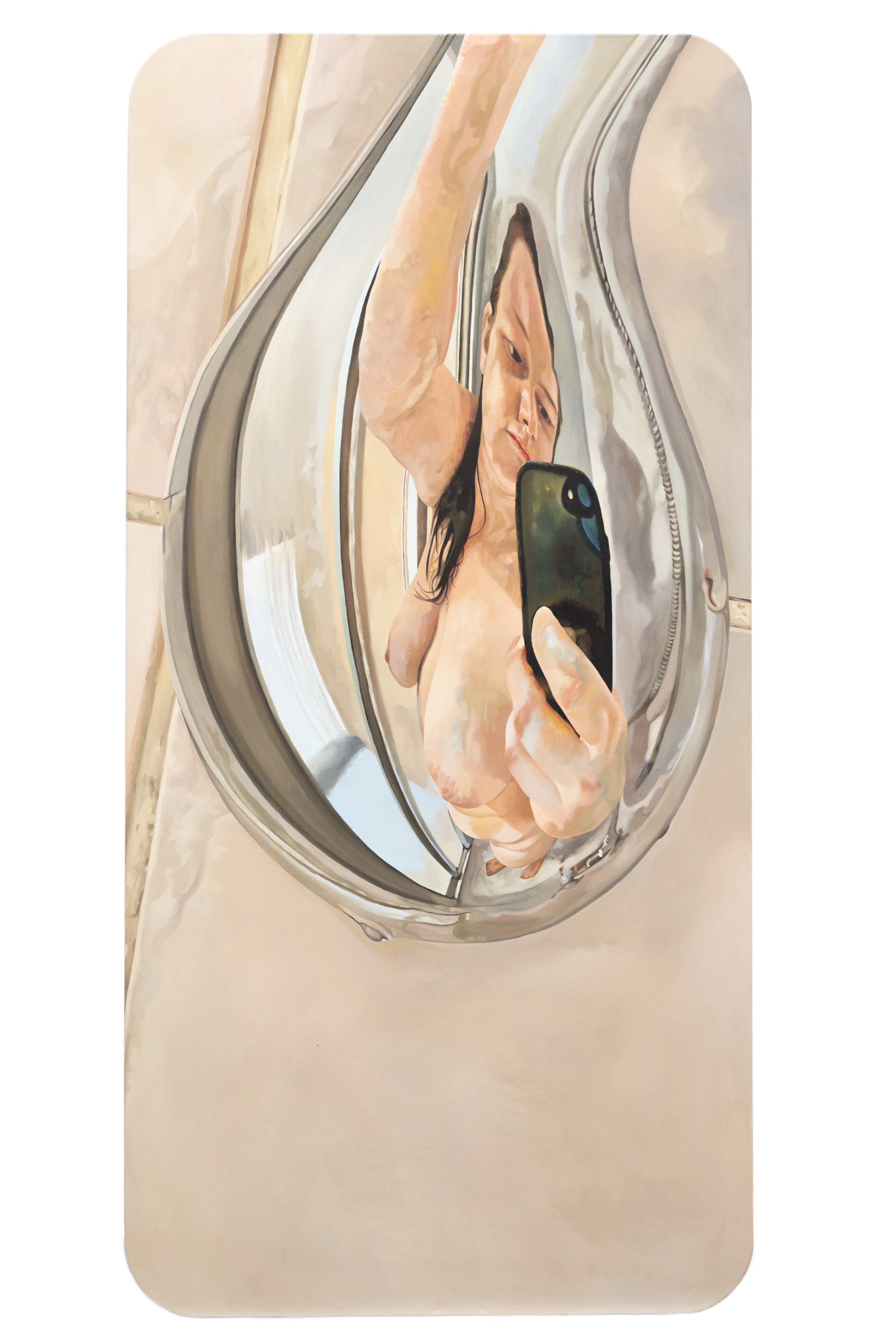


“Display #4”, oil on canvas, 200 x 200 cm (78,7 x 78,7 in), 2021, © photo: Julie Batteux

“Display #3”, oil on canvas, 140 x 140 cm (55,1 x 55,1 in), 2021
, © photo: Julie Batteux

“Display #2”, oil on canvas, 140 x 140 cm (55,1 x 55,1 in), 2021
, © photo: Julie Batteux
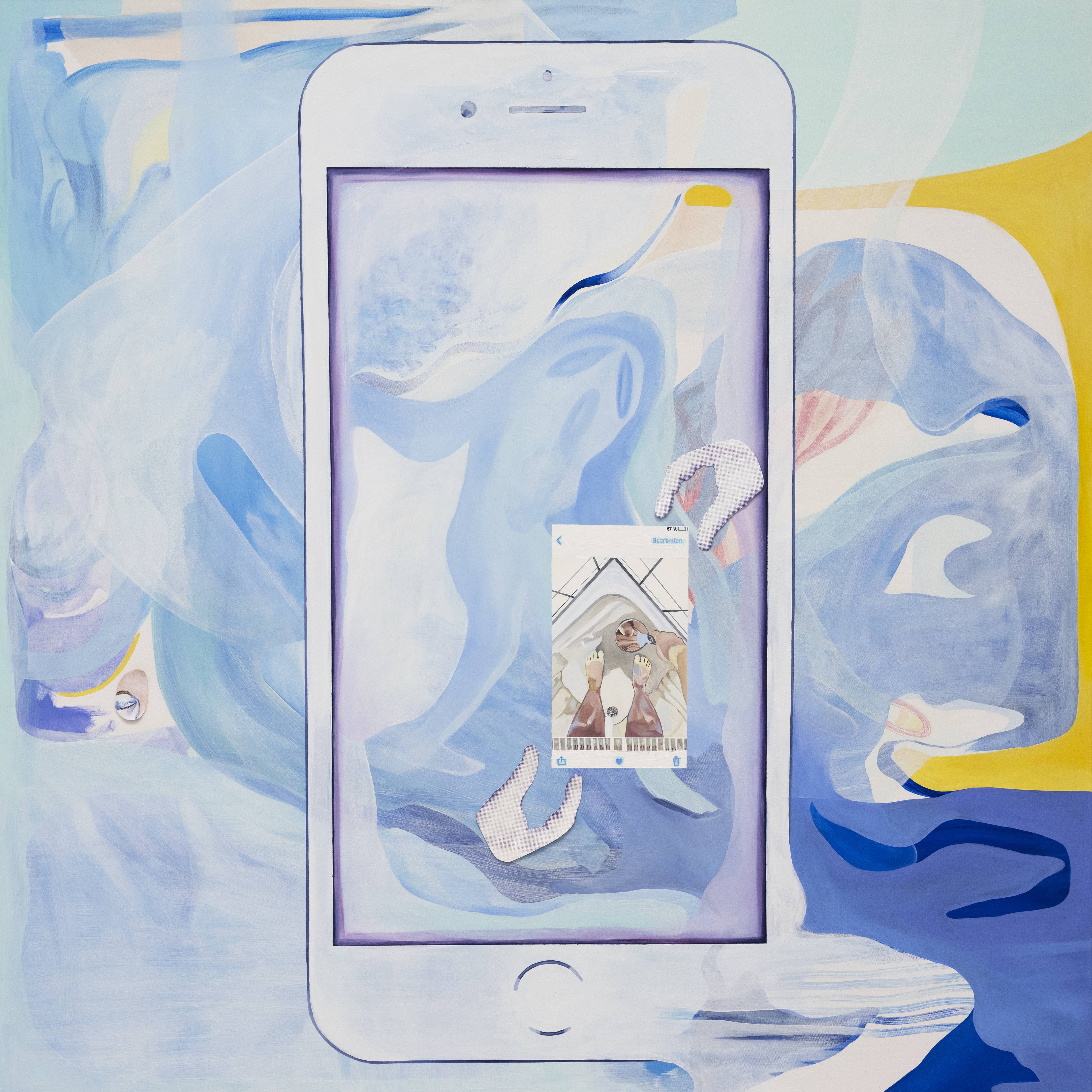
“Display #1”, oil on canvas/ screen printing, 140 x 140 cm (55,1 x 55,1 in), 2021, © photo: Julie Batteux

“An der Leine”, oil on canvas, 180 x 180 cm (70,8 x 70,8 in), 2020, © photo: Julie Batteux
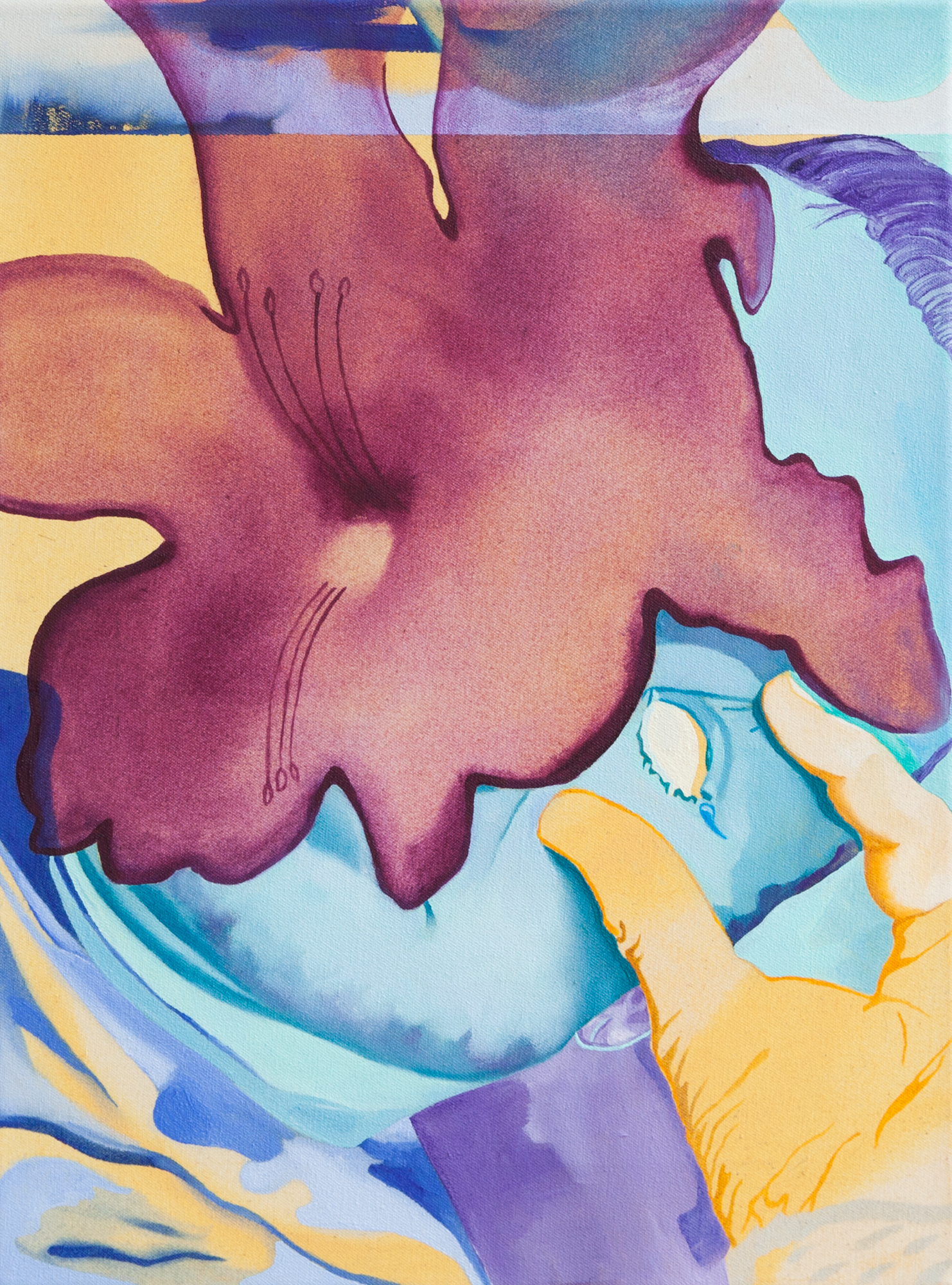
“Lilie”, oil on canvas, 40 x 30 cm (15,7 x 11,8 in), 2020
, © photo: Julie Batteux

“Schattengeist”, oil on canvas, 29 x 24 cm (11,4 x 9,4 in), 2017, © photo: Julie Batteux

“Meerbusen #1”, oil on canvas, 32 x 32 cm (12,5 x 12,5 in), 2020, © photo: Julie Batteux

“Schere und Stein”, oil on canvas, 29 x 24 cm (11,4 x 9,4 in), 2017, © photo: Julie Batteux

“Rednitz”, oil on canvas, 160 x 160 cm (62,9 x 62,9 in), 2020, © photo: Julie Batteux

“Nabel #2”, oil on canvas, 80 x 80 cm (31,4 x 31,4 in), 2020, © photo: Julie Batteux
Krallenmutter statement
EN
Since the beginning of my artistic research, I have been exploring the themes of motherhood and femininity, as well as the associated clichés and incarnations. I encounter these in various plays, films, advertising, social networks, and everyday life. In particular, the “Tradewives” movement on social networks currently romanticizes and glorifies a trend that carries patriarchal, right-wing indoctrination.
The hard-won rights and economic independence of women are being called into question. The fact that the idyllic family life visualized on the numerous “Tradewives channels,” in which the woman devotes herself to the breadwinner and subordinates herself to him, functions on the basis of a seemingly binary “natural” world order in which the woman freely chooses to be subordinate to the man, causes feminist nausea. In my photographic work with my own mother, I draw on stereotypes with visible ambivalence in order to question them and create discomfort in an alienating context.
My 2019 photo series “Krallenmutter” (Claw Mother) refers to the aesthetic devices of horror films and shows the happy housewife acting between children inflated like balloons and behind a concealing, suffocating latex mask. The many children she has inflated and is feeding with healthy fruit are probably taking the oxygen she needs to survive.
The photo series addresses the futile struggle of a mother who is at the mercy of social constraints and expectations. In my series, I stage tableaux with my own mother as the protagonist, who breaks out of her prescribed role in order to overcome the constraints and ideas of society. Although at first glance she appears to embody all the trappings of a housewife, with her costume, such as the apron with pink flowers, the iron, and the backdrop of a single-family home with a front yard, she attempts to break free from these social ideals. On closer inspection, one notices her discreet claw-like fingers and skin-colored latex mask, which suggest that she has mutated into a caged predator in this struggle for personal happiness. She is not surrounded by a cheerful crowd of children, but by balloons, placeholders with caricatured faces that convey a feeling of horror and inauthenticity to the viewer. These children are a brood of soulless props. They do not offer the hoped-for meaning of life. This dream cannot withstand the slightest scrutiny. The mother, struggling for freedom and individuality, resigns herself and cannot shake off her female masquerade. It seems that the mother falls victim to her own “pupation.” The supposed idyll turns out to be a horrible illusion. (Julie Batteux, 2026)
DE
Seit Beginn meiner künstlerischen Recherche beschäftige ich mich mit dem Thema Mutter und Weiblichkeit sowie den damit verbundenen Klischees und Inkarnationen. Diese begegnen mir in verschiedenen Theaterstücken, Filmen, der Werbung, sozialen Netzwerken und im Alltag. Insbesondere die „Tradewives“-Bewegung der sozialen Netzwerke romantisiert und glorifiziert aktuell einen Trend, der patriarchale, rechte Indoktrination im Gepäck hat. Die hart erkämpften Frauenrechte und wirtschaftliche Unabhängigkeit der Frauen werden in Frage gestellt. Dass die auf den zahlreichen „Tradewives-Kanälen“ visualisierte Familienidylle, in der die Frau sich dem Ernährer weiht und unterordnet, auf der Basis einer scheinbar binären „natürlichen“ Weltordnung funktioniert, in der die Frau dem Manne freigewählt untertan sein möchte, verursacht feministische Übelkeit. In der fotografischen Arbeit mit meiner eigenen Mutter greife ich mit sichtbarer Ambivalenz auf Stereotypen zurück, um sie zu hinterfragen und in befremdendem Kontext Unwohlsein zu erzeugen.
So verweist meine 2019 entstandene Fotoserie „Krallenmutter“ auf die ästhetischen Mittel des Horrorfilms und lässt die glückliche Hausfrau zwischen zu Luftballons aufgeblasenen Kindern und hinter einer kaschierenden, Luftnot erzeugenden Latexmaske agieren. Da nehmen die vielen Kinder, die sie aufgeblasen hat und mit gesundem Obst päppelt, wohl den Sauerstoff für das eigene Überleben.
Die Fotoserie thematisiert den vergeblichen Kampf einer Mutter, die gesellschaftlichen Zwängen und Erwartungen ausgeliefert ist. In meiner Serie inszeniere ich Tableaus mit meiner eigenen Mutter als Protagonistin, die aus ihrer vorgeschriebenen Rolle ausbricht, um die Zwänge und Vorstellungen der Gesellschaft zu durchbrechen. Obwohl sie auf den ersten Blick durch ihre Kostümierung, wie die Kochschürze mit rosa Blumen, das Bügeleisen und die Kulisse eines Einfamilienhaus mit Vorgarten allen Insignien einer Hausfrau entspricht, versucht sie, sich aus diesen gesellschaftlichen Wunschbildern zu lösen. Bei genauerem Hinsehen erkennt man ihre dezenten Krallenfinger und die hautfarbene Latexmaske, welche erahnen lassen, dass sie in diesem Kampf um privates Glück zu einem gefangenen Raubtier mutiert ist. Sie umgibt keine fröhliche Kinderschar, sondern Luftballons, Platzhalter mit karikaturistischen Gesichtern, die dem Betrachtendem ein Gefühl des Grauens, des Unechten vermitteln. Diese Kinder sind eine Brut seelenloser Requisiten. Sie bieten nicht den erhofften Sinn des Lebens. Dieser Traum hält keiner Stecknadel stand. Die um Freiheit und Individualität ringende Mutter resigniert und wird die weibliche Maskierung nicht los. Es scheint, dass die Mutter ihrer eigenen „Verpuppung“ zum Opfer fällt. Die vermeintliche Idylle entpuppt sich als horrible Illusion. (Julie Batteux, 2026)
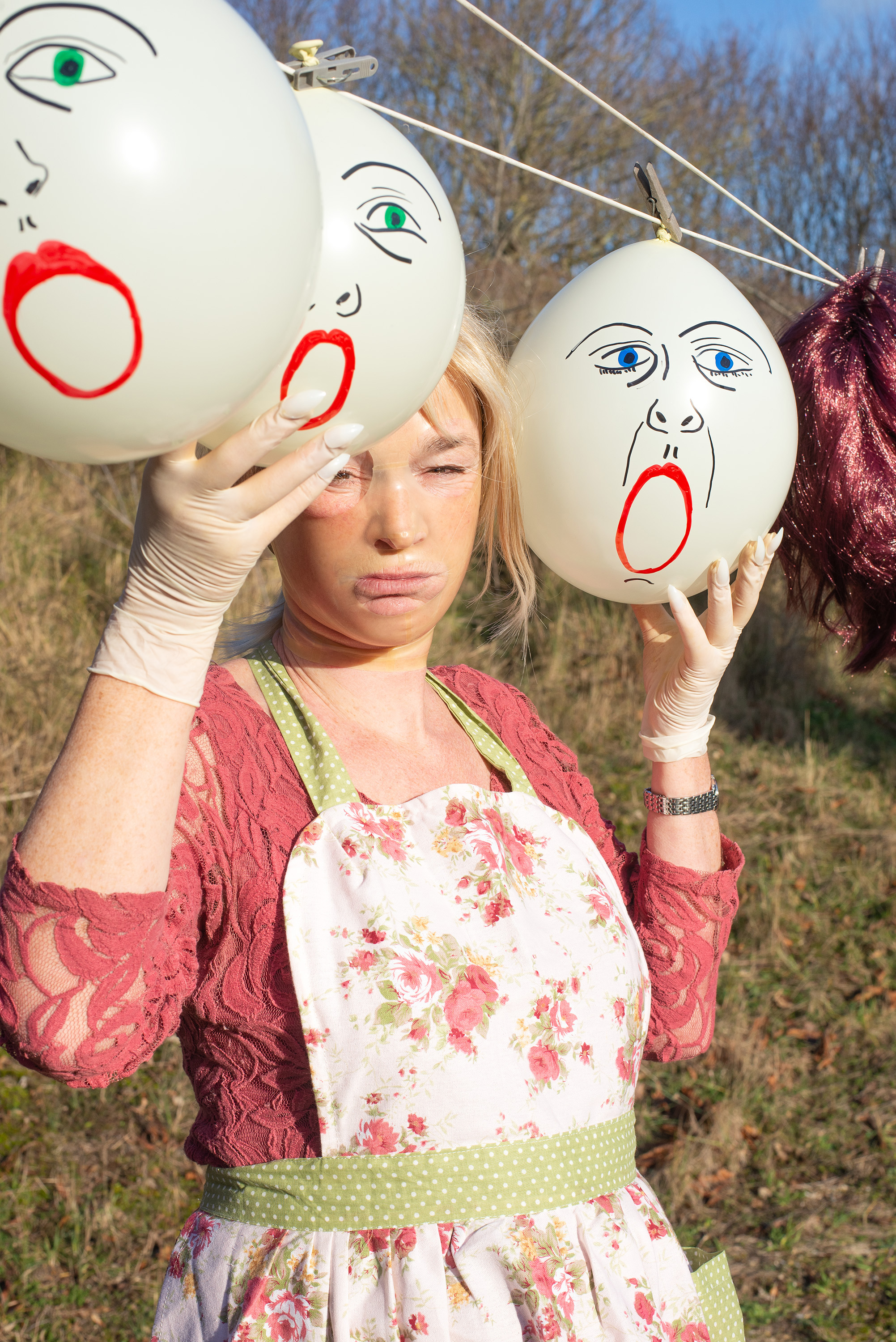
“Waschtag”, photography, dimensions variable, 2019, © photo: Julie Batteux
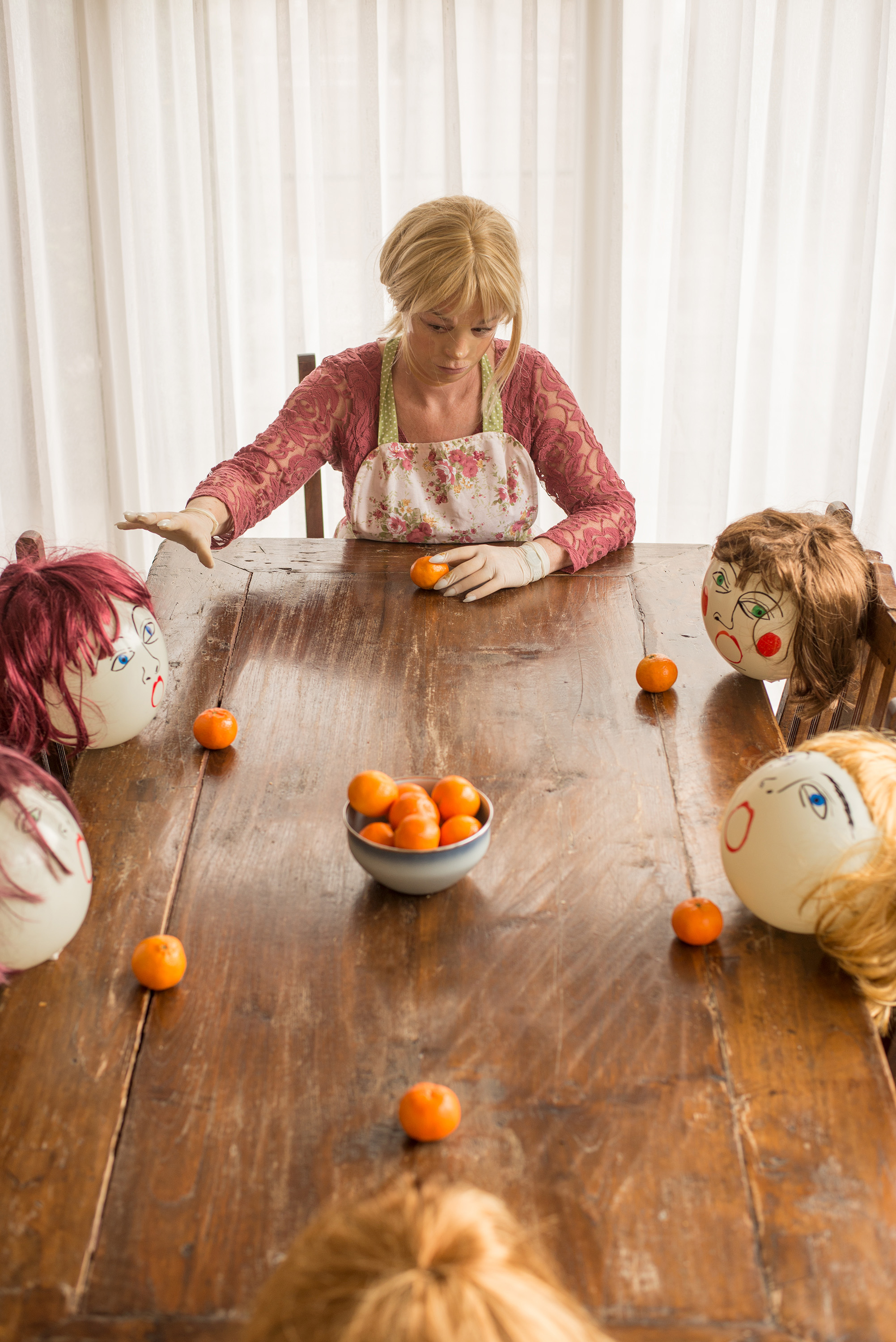
“Kinder zu Tisch”, photography, dimensions variable, 2019, © photo: Julie Batteux
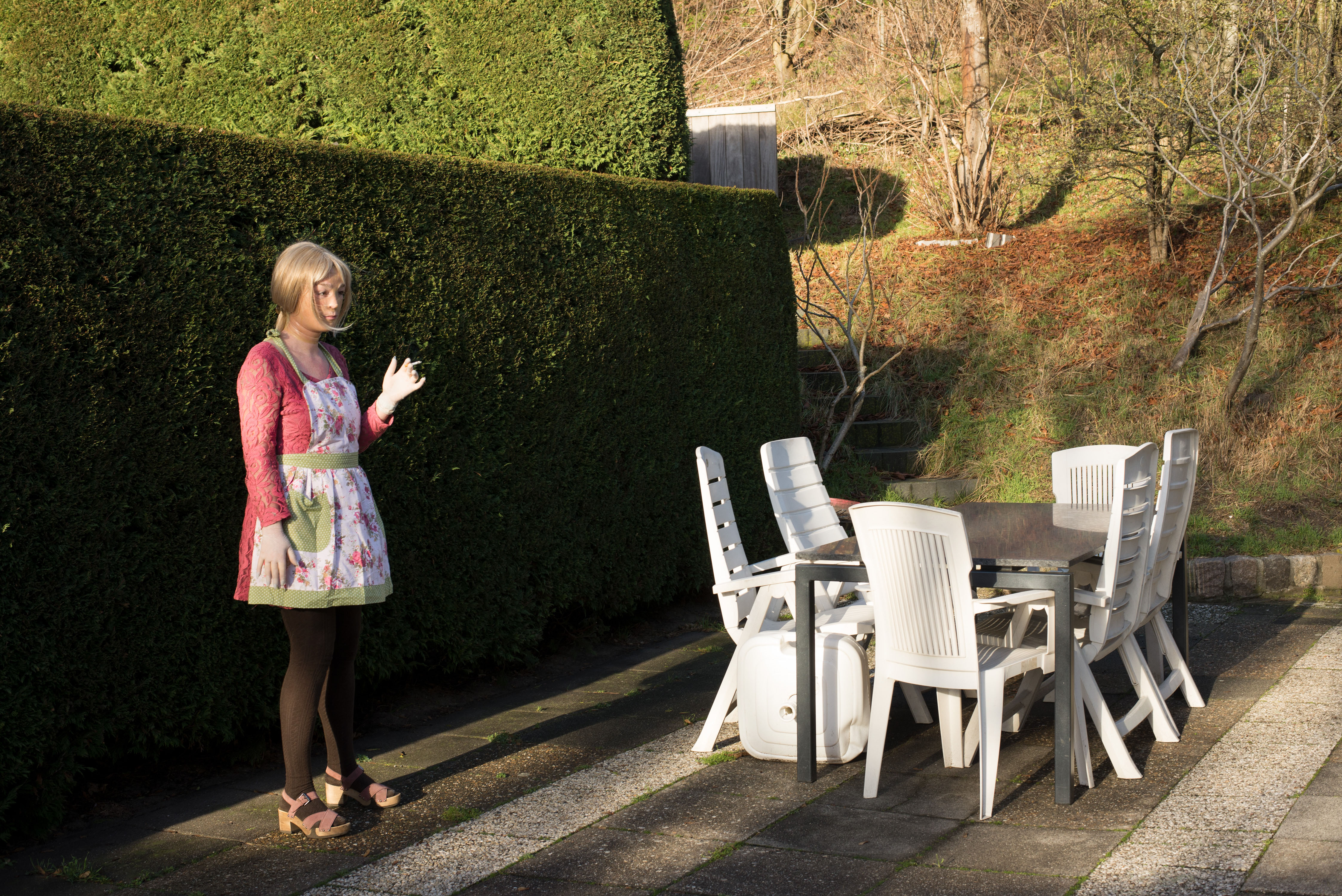
“Hinter jeder Hecke verbirgt sich ein Geheimnis”, photography, dimensions variable, 2019, © photo: Julie Batteux
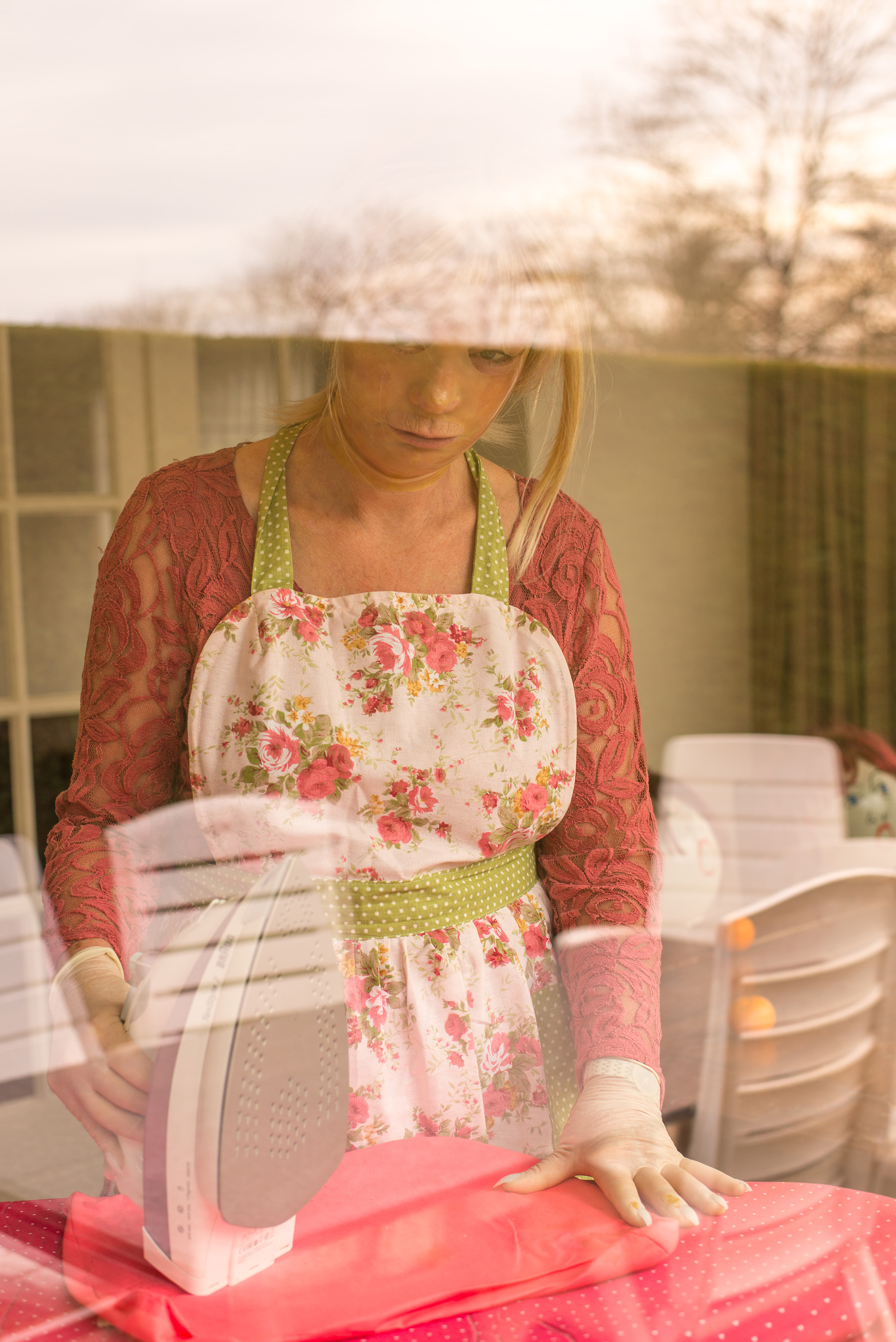
“Sonntag´s zum Tatort”, photography, dimensions variable, 2019, © photo: Julie Batteux
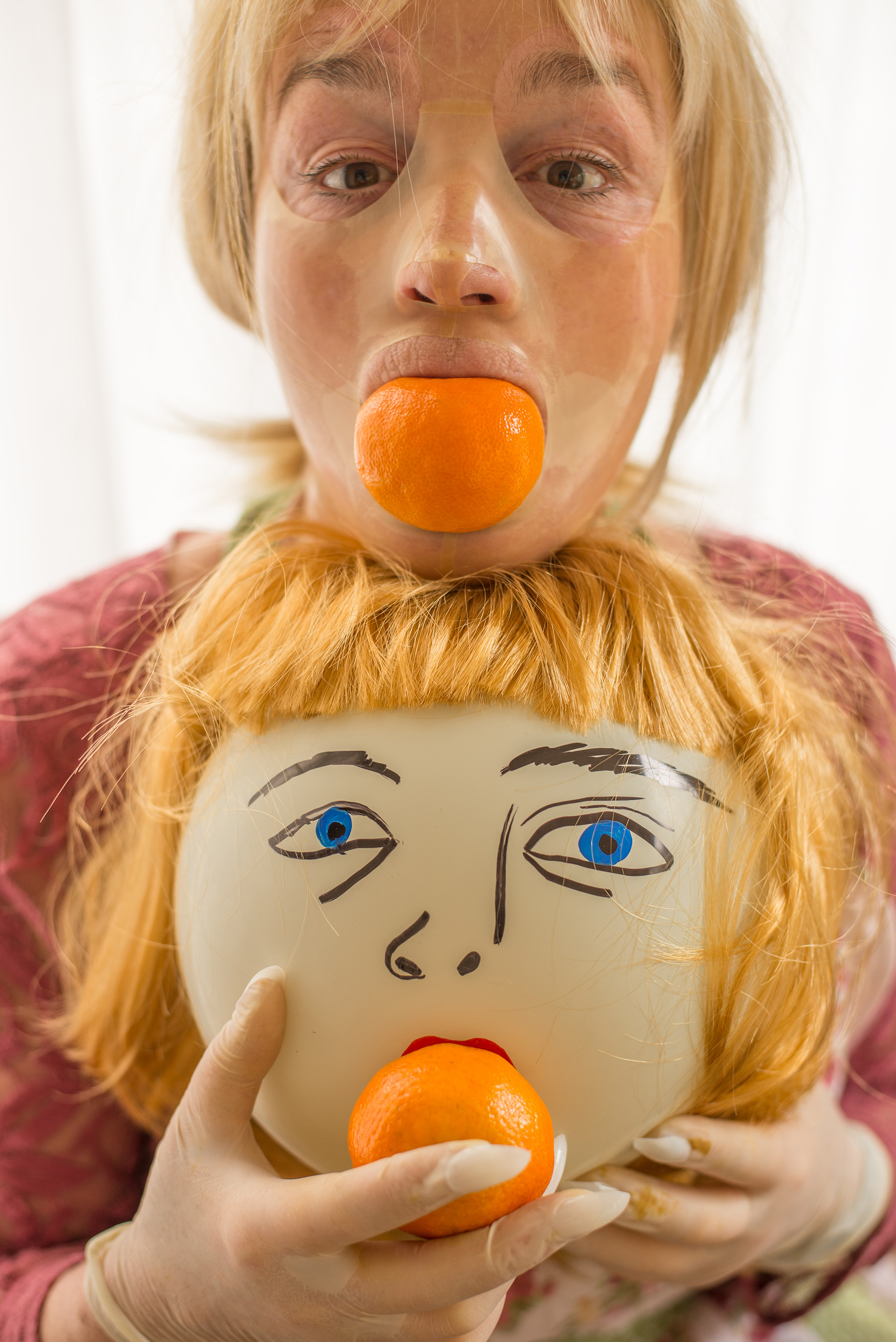
“Seelenloses Requisit”, photography, dimensions variable, 2019, © photo: Julie Batteux
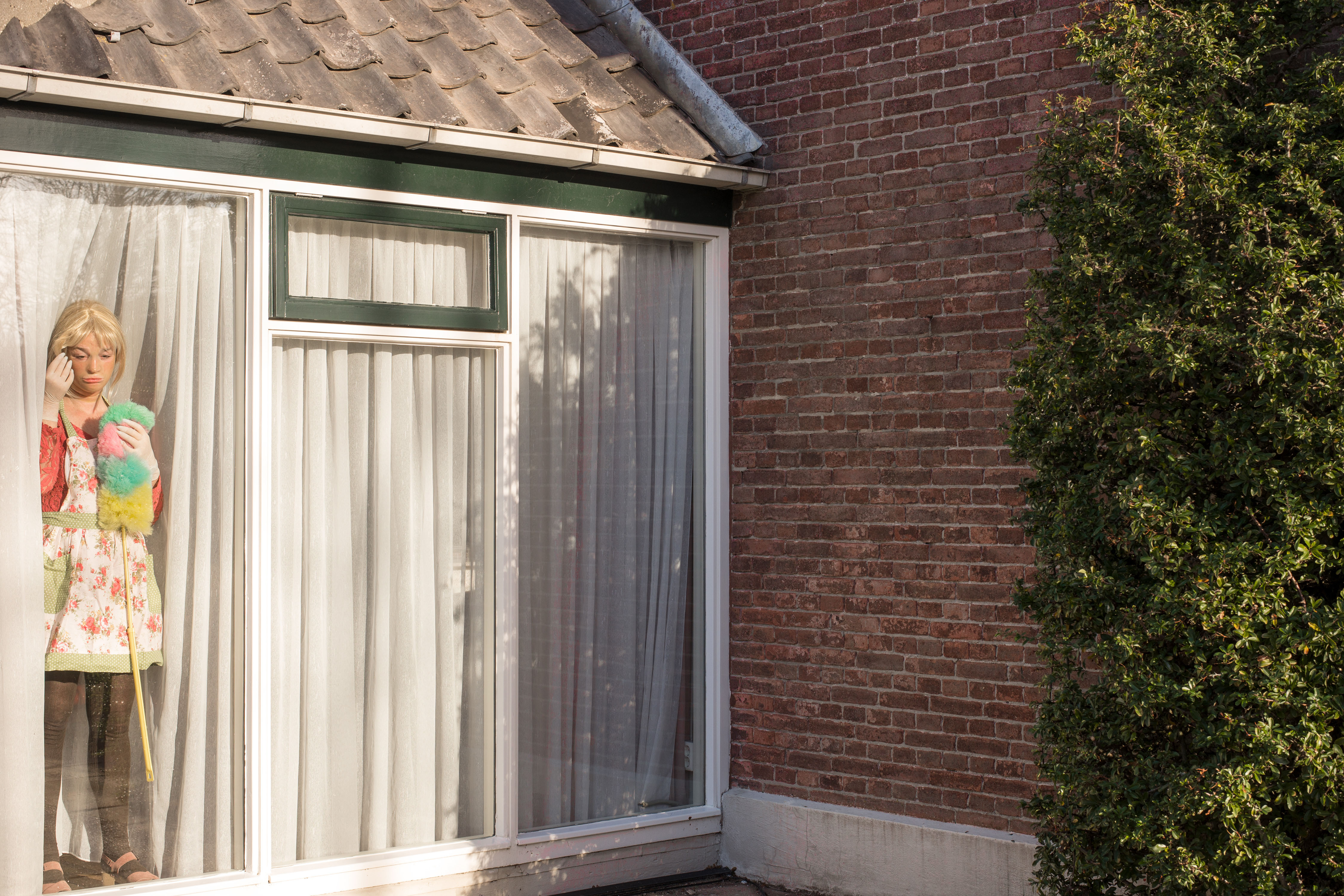
“Frage nach dem Sinn des Leben´s”, photography, dimensions variable, 2019, © photo: Julie Batteux
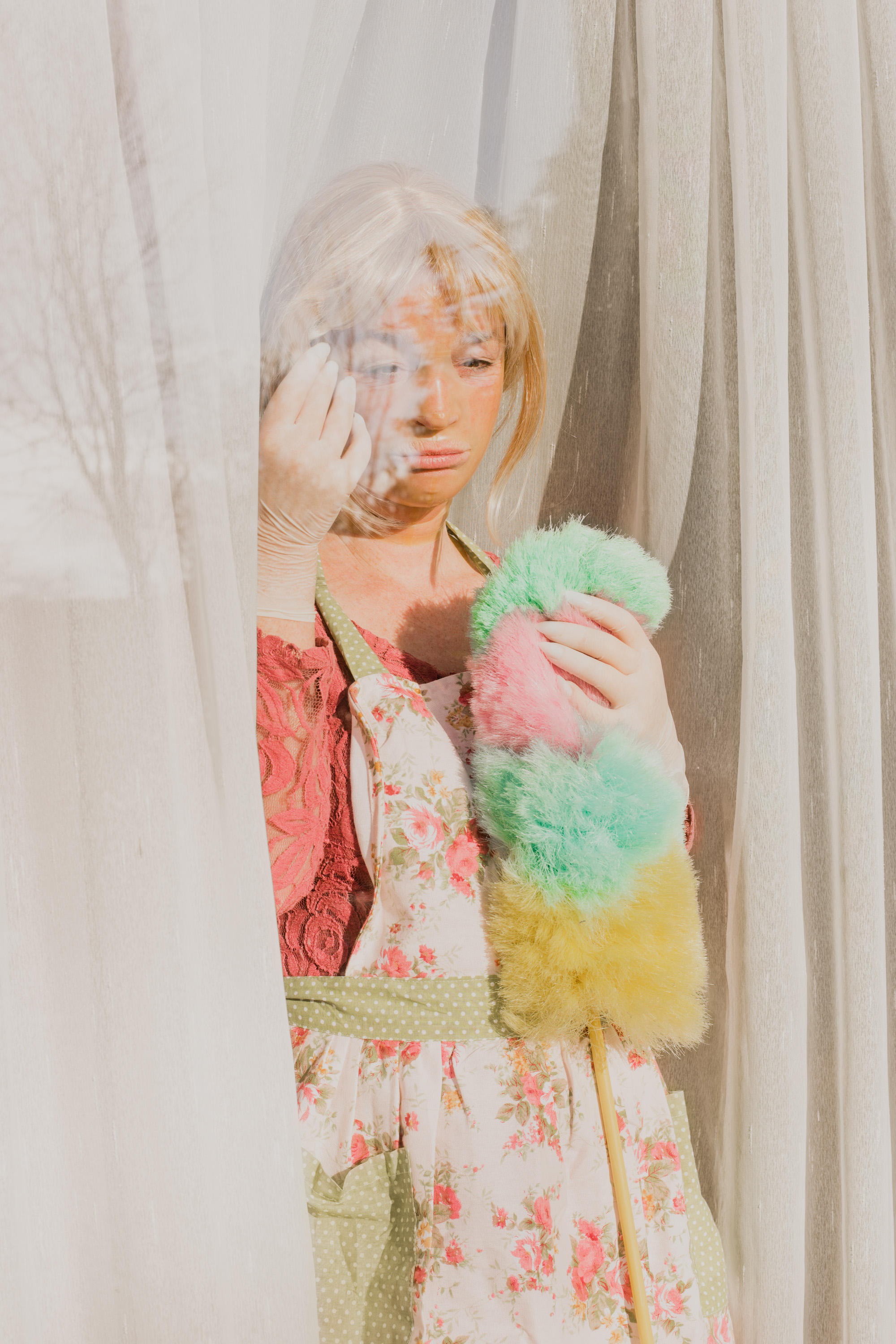
“Schritt aus der Scheinwelt”, photography, dimensions variable, 2019, © photo: Julie Batteux
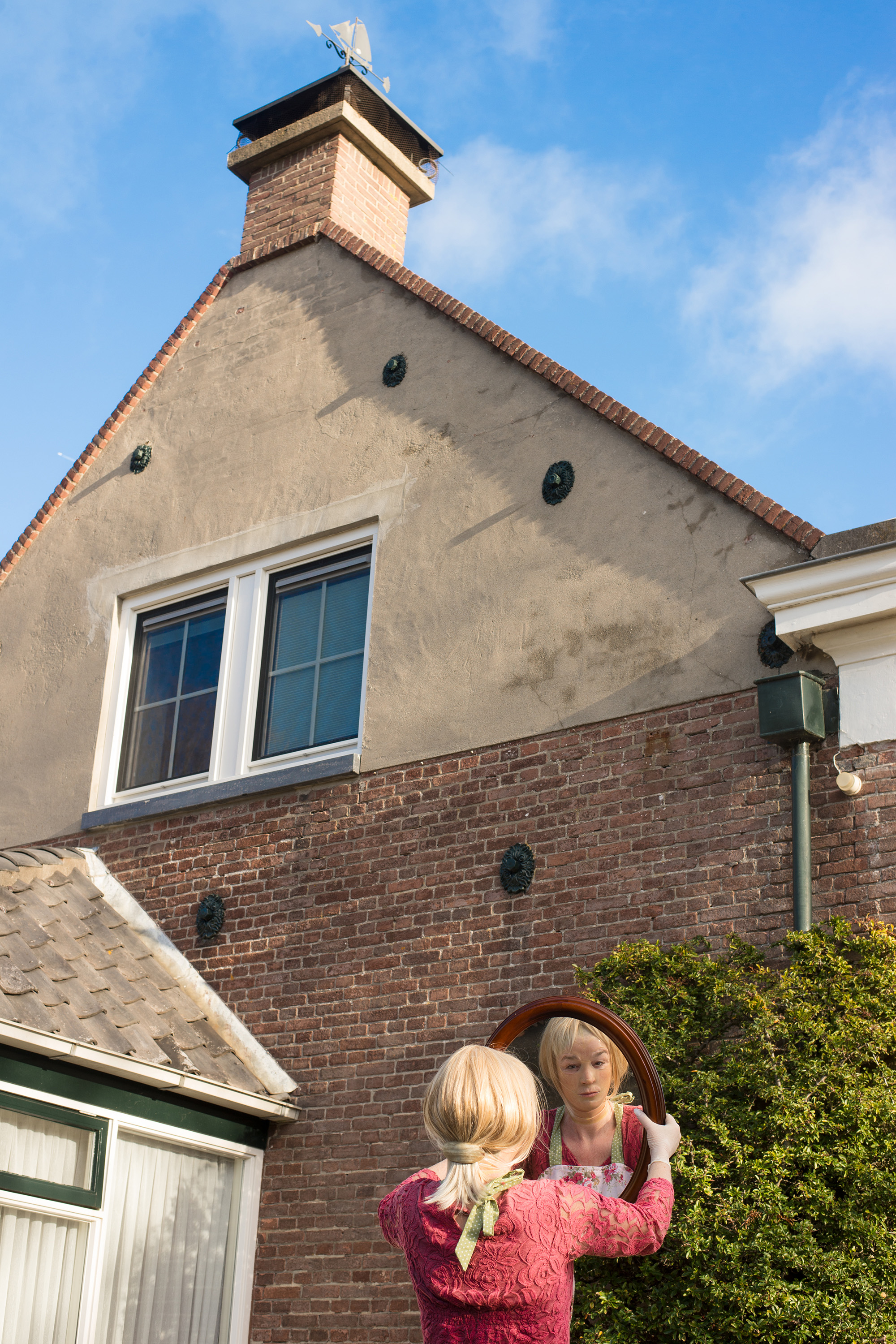
“Spieglein, Spieglein in der Hand”, photography, dimensions variable, 2019, © photo: Julie Batteux
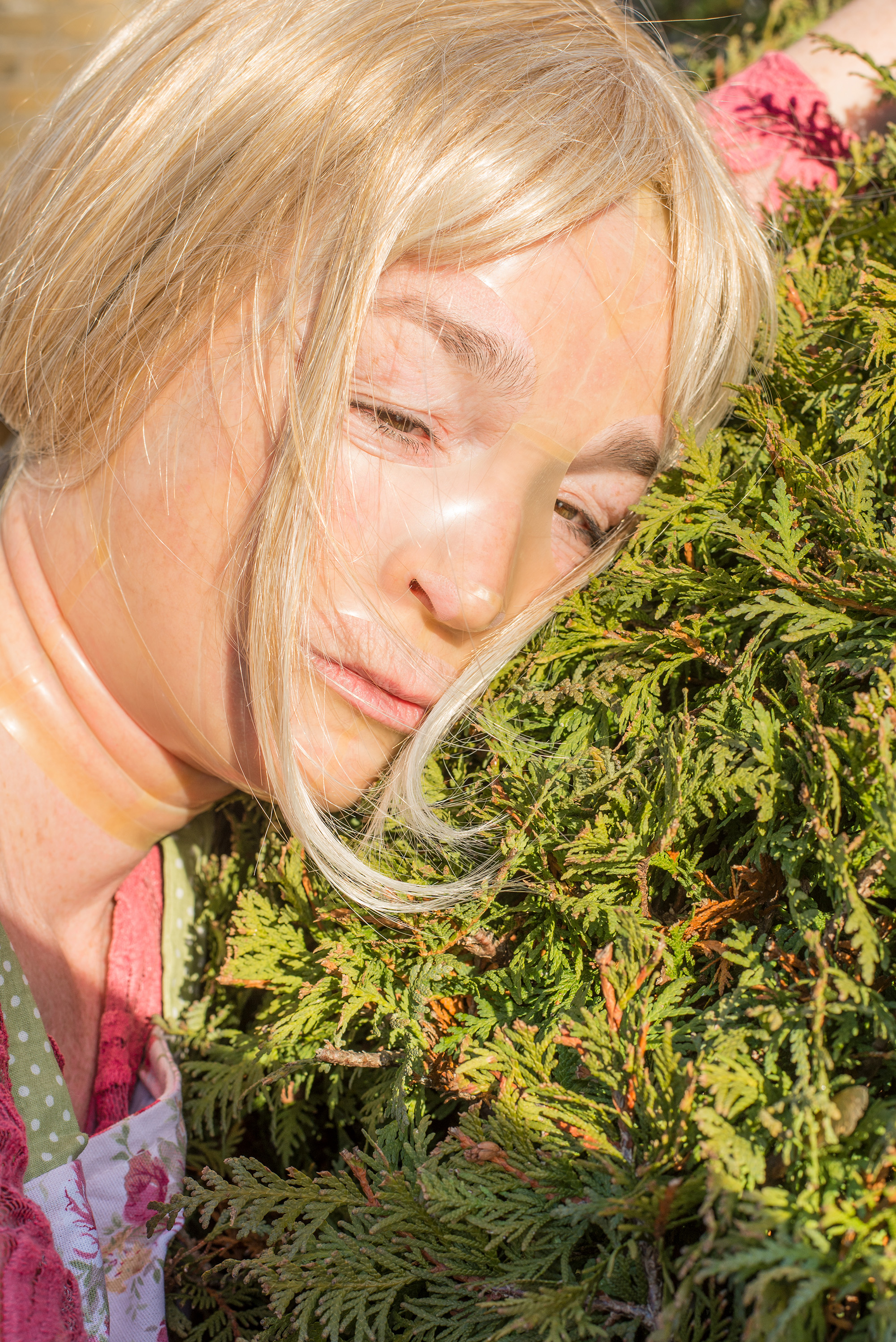
“Vermeintliche Idylle”, photography, dimensions variable, 2019, © photo: Julie Batteux
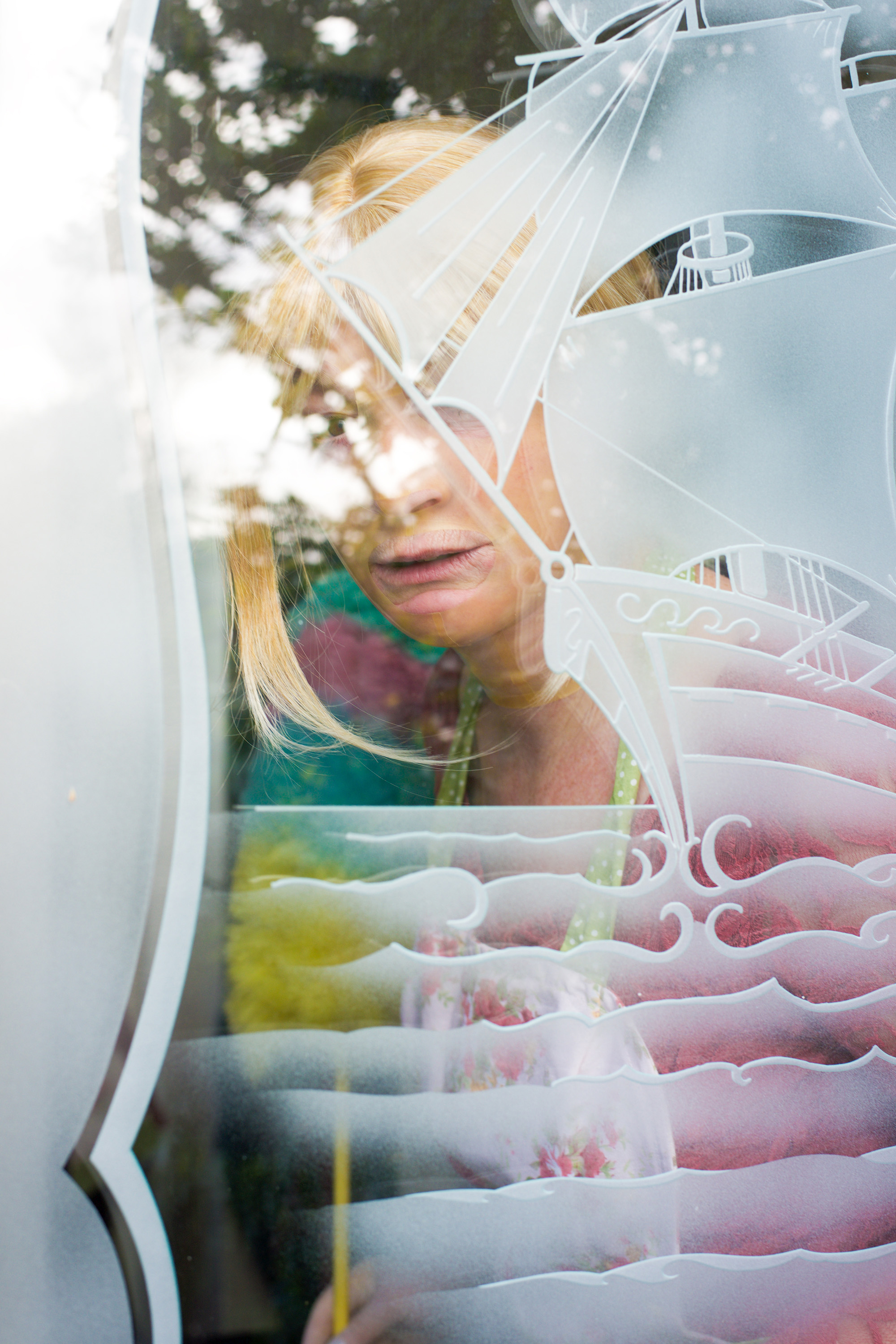
“Flucht über die Wellen”, photography, dimensions variable, 2019, © photo: Julie Batteux
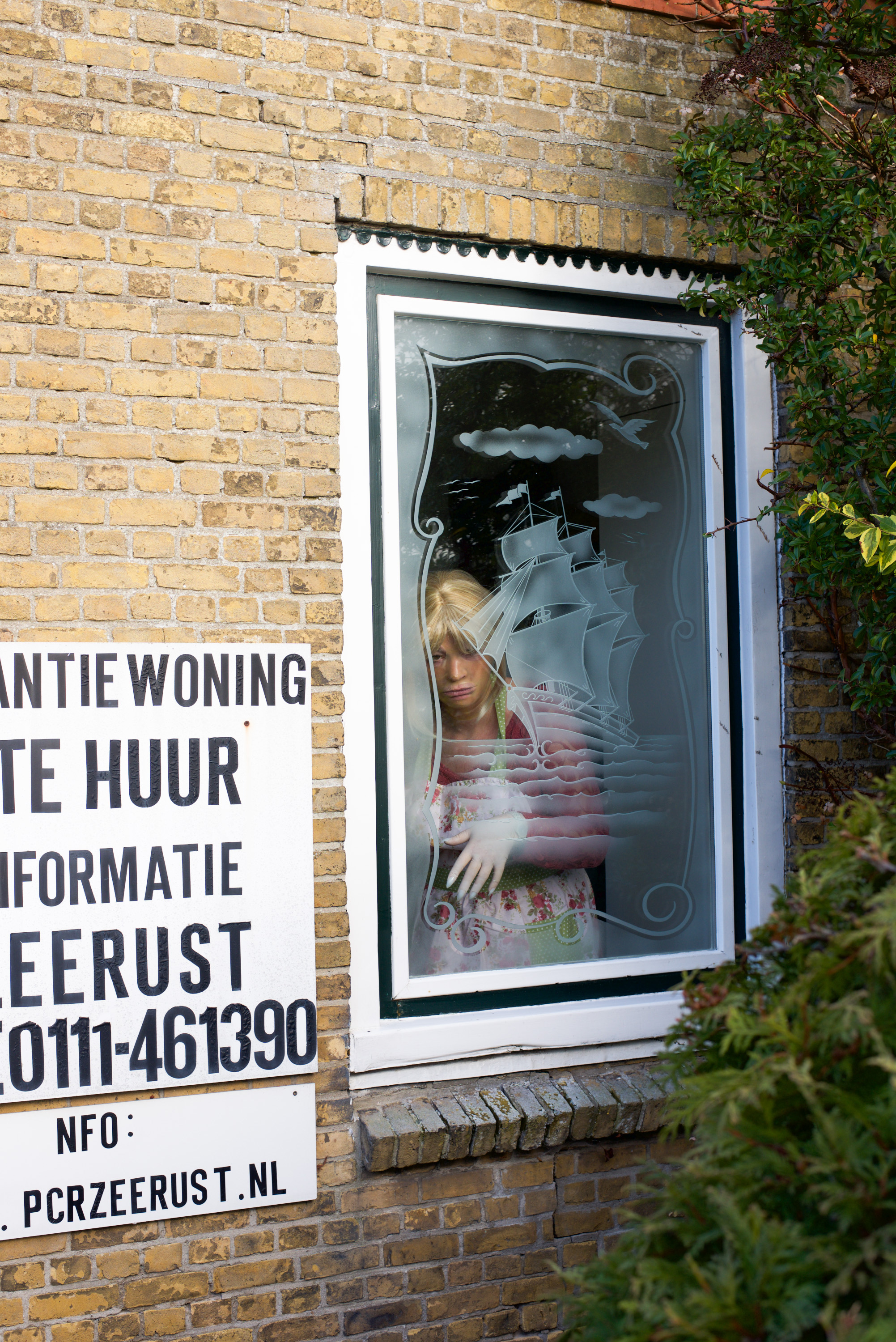
“Gefangendes Raubtier”, photography, dimensions variable, 2019, © photo: Julie Batteux
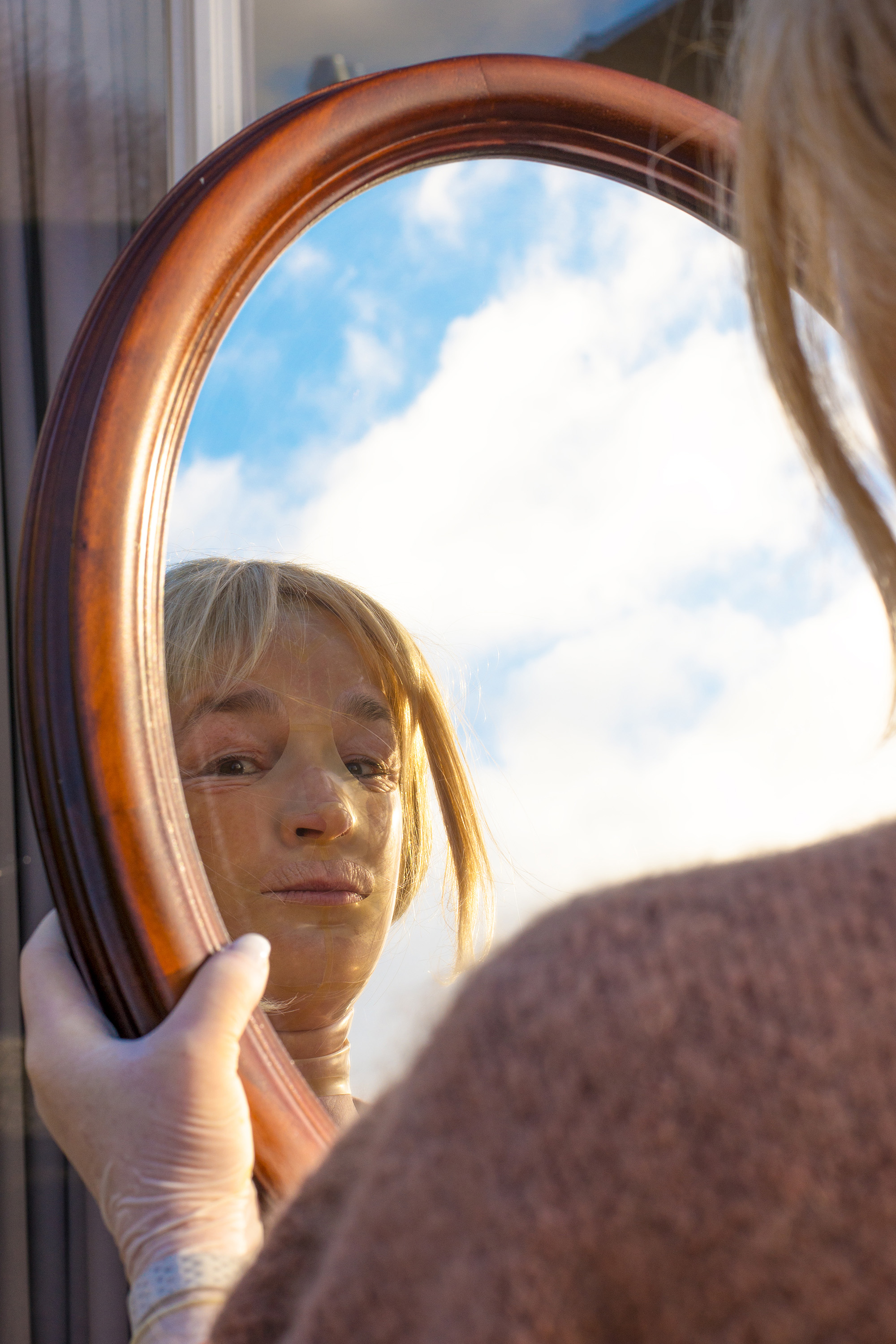
“Erkenntnisse im Sonnenlicht”, photography, dimensions variable, 2019, © photo: Julie Batteux
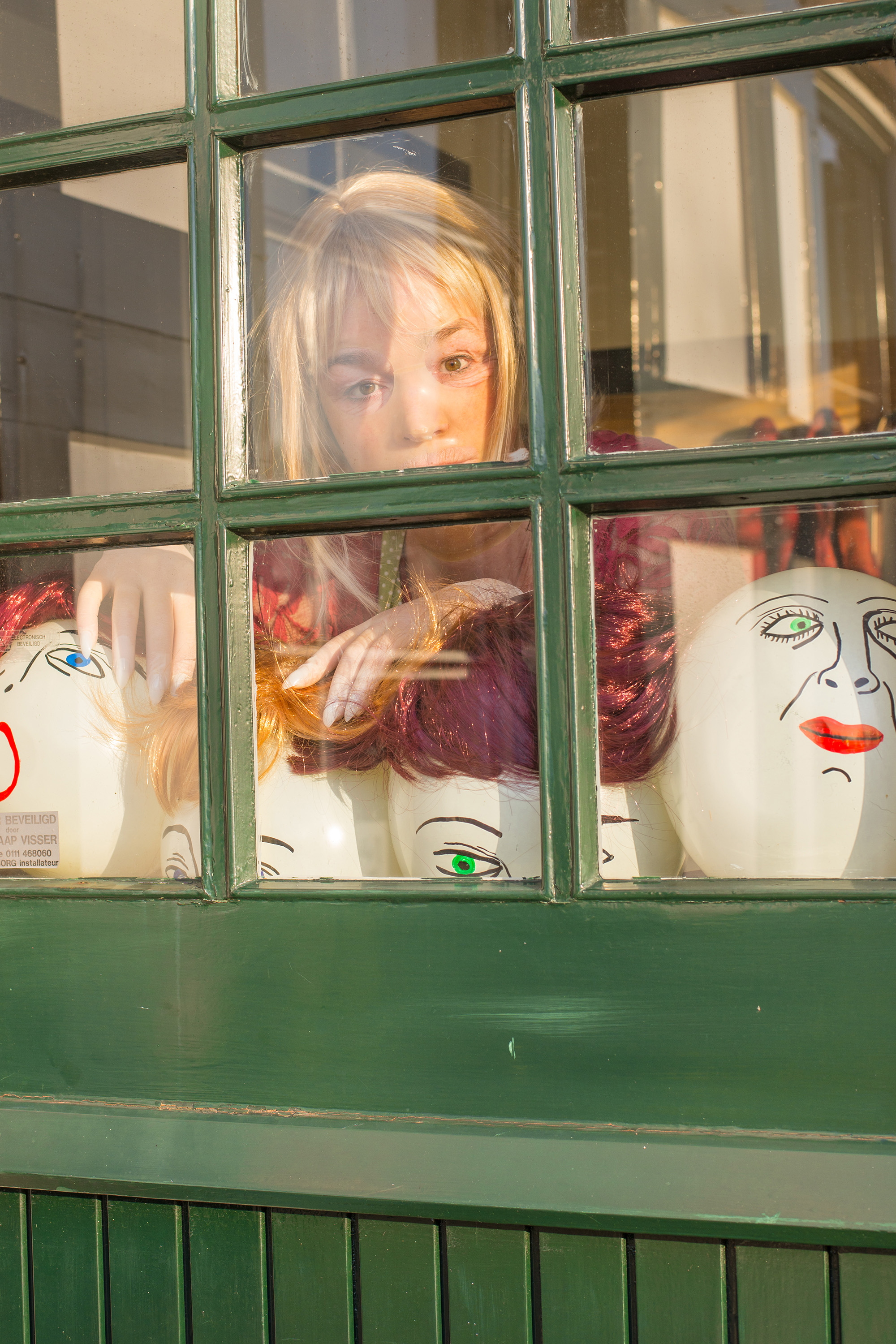
“Trügerische Aufreihung”, photography, dimensions variable, 2019, © photo: Julie Batteux